What is an IEP in Canada? An IEP, or Individualized Education Plan, is something many Canadian parents hear about for the first time after a diagnosis, a teacher’s concern, or a meeting they weren’t quite prepared for.
I’ve been exactly where you are. My daughter was diagnosed with ADHD, and navigating her IEPs taught me something nobody told me at the start: this document isn’t just paperwork. It’s the plan that directs your child’s entire school experience, including what support they receive, what goals the school works toward, and where funding flows. Getting it right matters far more than most parents realise.
This guide will walk you through what an IEP is, how it works across Canada, and why showing up prepared to that first meeting is one of the most important things you can do for your child.
What Does IEP Stand For, And What Do Canadians Call It?
An IEP in Canada stands for Individualized Education Plan. It’s a written document created by your child’s school team that outlines the specific supports, goals, and accommodations your child will receive to help them succeed in school.
You’ll hear this term used across most of Canada, but depending on where you live, the name might look a little different. Some variations you might see, depending on which province you live in:
- Ontario: Individual Education Plan (IEP)
- British Columbia: Individual Education Plan (IEP)
- Alberta: Individual Program Plan (IPP), though IEP is increasingly used as well
- Manitoba: Individual Education Plan (IEP)
- Saskatchewan: Individual Education Plan (IEP)
- Nova Scotia: Individual Program Plan (IPP)
- New Brunswick: Individual Education Plan (IEP)
- Prince Edward Island: Student Support Plan (SSP)
- Newfoundland and Labrador: Individual Support Services Plan (ISSP)
- Quebec: Individual Education Plan (IEP), or Plan D’Intervention (PI) in French-language schools
The names vary, but the purpose is the same: a personalised plan built around your child’s unique needs. If you’re not sure what your province calls it, your school’s resource teacher or special education coordinator will know.
One more thing to keep in mind if you’re searching for information online: most of the resources you’ll find are American. In the United States, the IEP is governed by federal law, which gives it a specific legal weight that doesn’t exist here in the same way.
In Canada, IEPs are regulated by each province’s Ministry of Education. They aren’t enforceable in court the way American IEPs are, but they are the official, documented commitment your child’s school makes to support them. If something isn’t in the IEP, there’s no guarantee it will happen.
What Is an IEP, Really?
At its most basic, an IEP is a written plan. It describes your child’s current level of learning, the goals the school will work toward, and the specific supports and services that will be put in place to help your child get there.
But here’s what most introductory guides leave out: the IEP is the governing document for your child’s education.
Everything flows from it. The support your child receives in the classroom, the accommodations a teacher puts in place, the funding the school allocates to your child’s needs – all of it is tied to what’s written in that plan. If a support isn’t in the IEP, the school isn’t obligated to provide it. If a goal isn’t documented, it isn’t being officially worked toward.
That’s not a criticism of teachers or school staff. Most of them genuinely want to help. But school boards operate within real constraints: funding caps, staffing limits, and a long list of competing priorities. The IEP is where those constraints meet your child’s needs, and what gets written down reflects both.
This is also why the IEP is sometimes called a “living document.” It’s reviewed regularly throughout the school year, and it can be updated as your child grows and their needs change. It isn’t set in stone after that first meeting. But the first meeting sets the tone, and what gets included early tends to shape everything that follows.
Think of it this way: the IEP is less like a report card and more like a contract. It’s the school’s written commitment to your child. And like any commitment, the details matter.
Who Gets an IEP?
This is one of the first questions most parents have, and it’s a fair question to have.
Not every child who struggles in school will have an IEP, and not every child with a diagnosis automatically receives one. Usually, what triggers the need for an IEP is when a student’s needs can’t be fully met through regular classroom instruction alone. That can look like a lot of different things.
Some children who have IEPs have diagnoses like:
- Autism Spectrum Disorder (ASD)
- Attention Deficit Hyperactivity Disorder (ADHD)
- Learning disabilities, such as dyslexia or dyscalculia
- Developmental delays
- Intellectual disabilities
- Physical disabilities or chronic health conditions that affect learning
- Speech and language needs
- Anxiety or other mental health conditions that significantly impact learning
But this isn’t a definitive list, and a formal diagnosis isn’t always required to get started. In many provinces, a school can begin developing a plan based on what teachers are observing in the classroom, even while a formal assessment is still underway. If your child is struggling right now and you’re still waiting on answers, you can ask your school what can be put in place in the meantime.
And if the school hasn’t brought it up, but you feel something needs to change, you don’t have to wait. Parents can request an IEP. It’s common that the conversation begins with the parents.
What Goes Into an IEP?
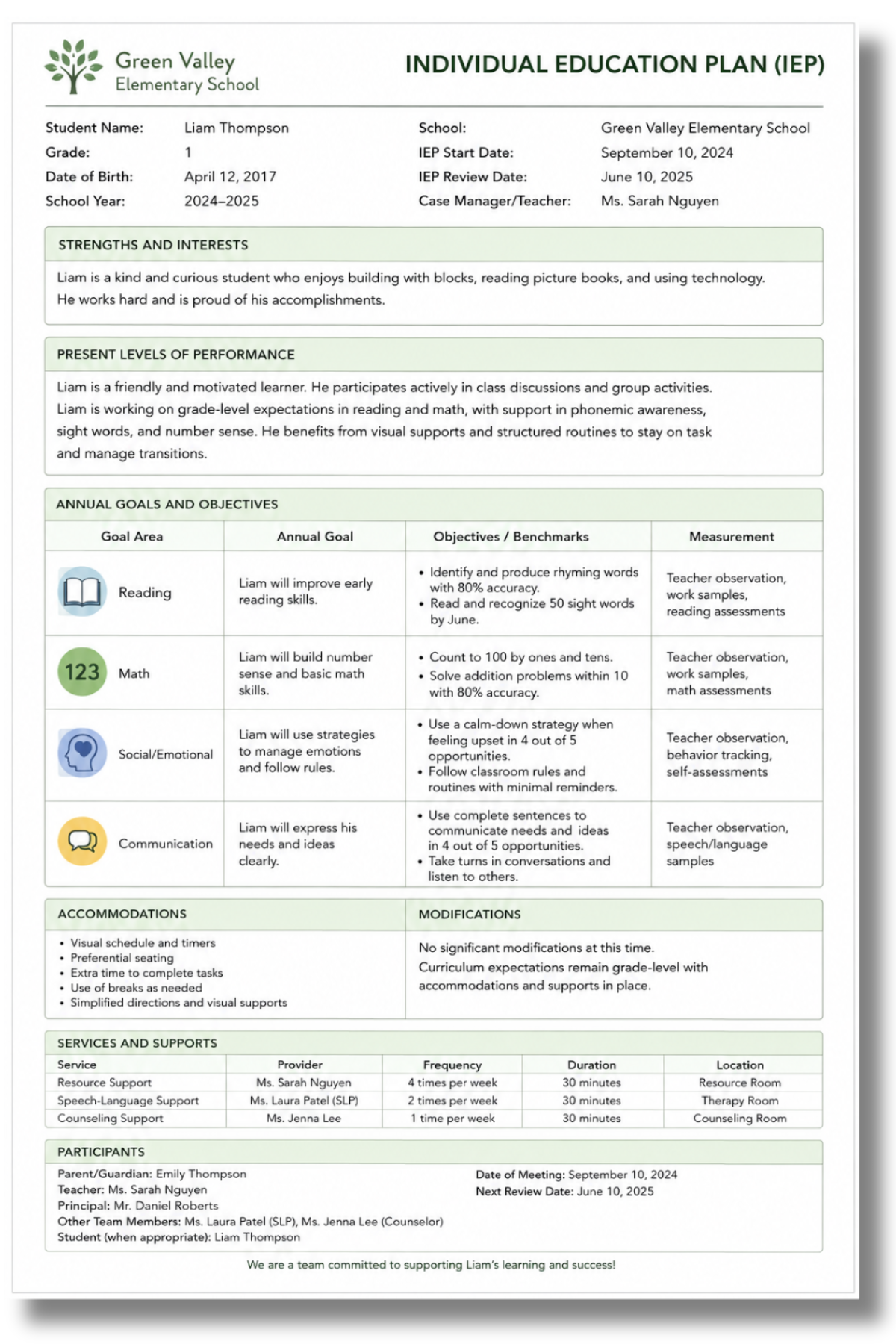
Every IEP looks a little different, because every child is different. But there are some core components you’ll see in almost every plan, and understanding what they mean before you walk into that meeting makes a real difference.
Here’s what you’ll likely talk about and document at your child’s IEP planning session:
A snapshot of where your child is right now
The IEP starts with a description of your child’s current strengths and needs. This is sometimes called the “present level of performance.” It’s the starting point or the baseline the school uses to set goals and measure progress. It should reflect your child as a whole, not just where they’re struggling.
Goals
From that baseline, the team sets learning goals for the year. These should be specific and measurable, not vague. “Improve reading” isn’t a goal. “Read and comprehend grade-level texts with 80% accuracy by June” is a goal. If the goals in your child’s IEP feel unclear or too easy, you have the right to ask questions until you understand.
Accommodations
Accommodations are changes to how your child learns or demonstrates their learning, without changing what they’re expected to learn. Some examples of possible educational accommodations are:
- extra time on tests
- a quiet space to write exams
- access to text-to-speech technology
- permission to submit work orally instead of in writing
They are meant to level the playing field without lowering the bar.
Modifications
Modifications are different, and this distinction matters. A modification changes what your child is expected to learn, not just how they learn it. Some examples of modifications are:
- fewer questions on a test
- work from a lower grade level curriculum
- reduced curriculum expectations
They can be appropriate and helpful in the right circumstances, but they also carry long-term implications for how your child’s progress is assessed and reported. It’s important to understand exactly what’s being modified and why, and what it might mean for your child’s future.
Services and supports
The IEP will also outline any additional services your child will receive: Some examples of services and supports your child might receive:
- time with a resource teacher
- speech-language therapy
- educational assistant support in the classroom
These aren’t extras, they’re commitments. And like everything else in this document, if it isn’t written down, it isn’t guaranteed.
From My Experience
When my daughter was in middle school, her IPP included modifications that looked great on paper. She was getting A’s consistently, and on the surface, everything seemed fine. But she was getting ten questions on a test instead of fifty.
I started calling them “fake A’s” — because the grades were real, but the learning wasn’t keeping up. She was achieving in a way that met the school’s benchmarks, not in a way that was helping her grow or building the skills she’d need later.
The difference between those early meetings and the ones that came later in high school was preparation. By the time we got to high school, I knew what modifications I wanted, what goals they were tied to, and how to ask for them by name. I knew what questions to ask and what to push back on. That preparation changed everything about what ended up in her plan — and everything about what she got out of school because of it.
Walking into an IEP meeting without preparation is a little like signing a contract without reading it. The meeting moves quickly, the team knows the system far better than most parents do, and what gets decided in that room is what your child lives with for the rest of the year.
What Happens at an IEP Meeting?
If you’ve never been to an IEP meeting before, knowing what to expect makes a big difference. These meetings can feel overwhelming, especially when you’re sitting across from a room full of educators who speak a language you’re still learning.
Here’s what typically happens.
Who’s in the room
An IEP meeting usually includes your child’s classroom teacher, a special education teacher or resource teacher, and a school administrator, often the principal or vice principal. Depending on your child’s needs, other professionals may also be present, such as a speech-language pathologist, an occupational therapist, or a school psychologist. You are part of this team. You are not an observer. You’re a participant with an equal seat at the table.
Depending on their age and comfort level, your child may also attend. In many provinces, students who are older are encouraged or even expected to be involved in their own planning.
What gets discussed
The team will review your child’s current progress, discuss what’s working and what isn’t, and propose goals and supports for the coming term or year. You’ll have the opportunity to share your own observations about your child, such as what you’re seeing at home, what your child is telling you about school, and what you feel is missing.
Your observations matter in this discussion more than you might think. You know your child in ways the school team simply can’t.
What gets decided
The supports, accommodations, modifications, and services that go into the IEP are agreed upon in this meeting. Once the plan is finalised and signed, it becomes the document that guides your child’s education until the next review.
Here’s something you should know before you go in: you aren’t meant to be a passive participant. You can ask questions before anything is finalised and even take the document home to review it before signing. You can also raise concerns and request that changes be made.
The specifics of your rights will vary by province, so it’s worth checking with your school board about the process in your area. But in every province, your voice is meant to be part of this.
IEPs are typically reviewed two to three times per year, depending on your province, and they can be updated at any time if your child’s needs change significantly. If something isn’t working, open up dialogue with your child’s teacher and principal.
A Note for Newcomer and Immigrant Families
If you’re new to Canada, navigating the school system on top of everything else that comes with settling into a new country can feel overwhelming. The IEP process is no exception. And if you come from a place where parents weren’t expected to weigh in on their child’s education, or where schools simply made decisions and families followed along, the way this process works here might feel unfamiliar.
The most important thing to know is this: in Canada, you are considered part of your child’s education team.
Your observations, your knowledge of your child, and your voice are meant to shape the plan. That’s not just an expectation, it’s how the process is designed to work.
If English isn’t your first language:
If English isn’t your first language, it’s worth asking the school whether interpreter support is available for IEP meetings. Many schools and school boards can arrange this, often at no cost to you, but the level of support varies depending on where you live. Ask as early as possible, and ask in writing so there’s a record of the request. And regardless of what support is available, your child should never be put in the position of interpreting for you in a meeting about their own education. You can always bring your own translation support person if your school board doesn’t offer this service.
You can also ask for important documents to be explained to you in your preferred language. If something isn’t clear, ask for clarification. Signing a document you don’t fully understand isn’t something you should ever feel pressured to do.
If you had a similar plan in place for your child in your home country, bring any documentation you have to share with the school team. Even if it’s in another language, it can help give the team a clearer picture of your child’s history and needs.
The IEP process can feel intimidating even for parents who grew up in the Canadian school system. Going in with a little information goes a long way, and you deserve to feel as prepared and confident as any other parent in that room.
Why Preparation Changes Everything
I want to be honest with you about something, because I wish someone had been honest with me earlier.
School boards operate within real constraints. Funding caps, staffing limits, and a long list of students with competing needs mean that IEP teams are working within a system that has boundaries. The people in that room are not your adversaries. Most of them genuinely care about your child. But they are also bound by what the system can accommodate, and they won’t always volunteer everything that’s available.
What gets written into your child’s IEP is often a reflection of two things: what your child needs, and what a prepared parent asked for.
When my daughter was in middle school, I let the team lead. I assumed they knew best, and I trusted that what they put in front of me was the full picture. What resulted was a plan that helped her pass. She was getting consistent A’s, and I thought that meant things were going well. It took me a while to realise that she was getting ten questions on a test instead of fifty. The grades were real. The growth wasn’t keeping up. I started calling them “fake A’s” — and that’s exactly what they were.
By high school, I approached her IPP completely differently. I came in knowing what modifications I wanted, what goals they were tied to, and how to ask for them by name. At one point, a slightly frustrated member of the team asked if I was a teacher. I’m not. But I had prepared like one, and I was asking for things they didn’t necessarily want to have to provide.
Because I pushed for the right things, my daughter’s education started being guided by her actual strengths. The barriers that had been quietly holding her back got real attention. She finished high school with genuine confidence, went on to university, and today she works in a K-12 school here in Calgary. I believe that knowing how to guide that IEP process gave her all the skills and confidence she needed to succeed throughout her entire education and into adulthood.
The difference between those two experiences wasn’t my daughter. It was me, and how prepared I was walking into that room.
A well-prepared parent doesn’t just help their child get through school. They help their child get somewhere.
Frequently Asked Questions About IEPs
In most provinces, an IEP is reviewed two to three times per year, typically at the start of the year, and then around the same time report cards go home. It can also be updated at any point during the year if your child’s needs change significantly. If something isn’t working, you don’t have to wait for a scheduled review to raise it with the school team.
An accommodation changes how your child learns or demonstrates their learning, without changing what they’re expected to learn. Extra time on a test, a quiet room for exams, or access to text-to-speech software are all accommodations. A modification changes what your child is expected to learn. Fewer questions, reduced curriculum expectations, or to work from a lower grade level are all examples of modifications. Both can be appropriate depending on your child’s needs, but it’s important to understand which one is being proposed and why, because they have different implications for how your child’s progress is measured and reported.
Yes. The IEP should be a collaborative document, and as a parent you have the right to raise concerns and request that changes be considered. If you feel something is missing, or that a goal isn’t ambitious enough, start by bringing it up with the resource teacher or special education coordinator. Put your requests in writing so there’s a record of the conversation. Email is excellent for creating a paper trail.
Start by talking to the school team directly, since they can work with you on many of your concerns at that level. If you’re not getting traction, you can escalate to the school board’s special education department. Most provinces also have formal processes for disputes, which can include mediation. Checking your provincial Ministry of Education website is a good starting point for understanding your specific rights and options.